
About a week ago, on November 5 and 6, I was in Durham, North Carolina, for Tech SEO Connect, and I heard some really great talks on how large language models actually work. Two speakers in particular stuck with me. Krishna Madhavan is a principal product manager at Microsoft AI, and Anfal Siddiqui is a researcher at Google DeepMind and one of the co-authors of the FACTS benchmark, which DeepMind built to measure and score how factual LLMs are. Both of them spent a lot of time on what's happening under the hood when an LLM gives you an answer.
I've been thinking about it ever since, mostly because it has me asking a pretty basic question about my own work. As a GEO consultant, my job is to get people, businesses, and brands recommended by LLMs. So what does that job actually involve? What does it entail day to day?
Where I've landed is two phrases I want to introduce. The first is association stuffing, which I think is the shortcut a lot of people are going to reach for. The second is association equity, which is the version I think is actually worth building. To explain either one, though, I need to back up a little and talk about how these models learn what a brand means in the first place.
How LLMs Learn What Your Brand Means
Before the conference, I'd already been doing some of my own research on open weight models, the ones you can download and run on your own machine. Early on, the question I kept trying to answer was this: when you download an open weight model, how are you downloading enough of the world's information for it to give you good answers?
The problem in my thinking was that you aren't downloading all of the world's information onto your machine. What you're downloading are weights, and weights are numbers. So when you download an 8 billion or 16 billion parameter model, you're basically getting 8 billion or 16 billion learned numbers. The larger the model, the more room it has for information and for the associations it uses to figure out meaning.
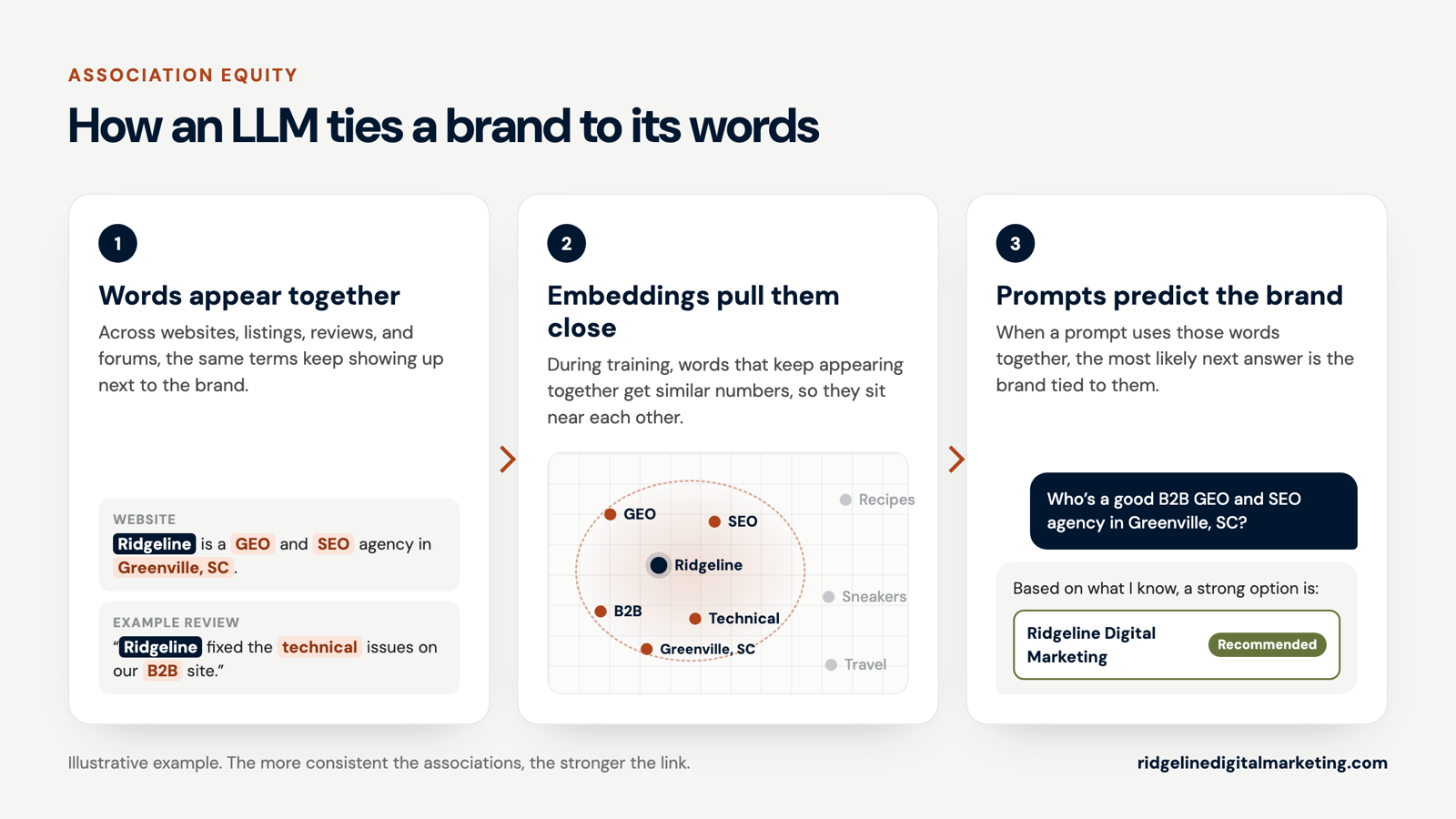
So where do those numbers come from? A big part of it is something called vector embedding. As a model learns from text, words that show up together often get associated with one another, and they get turned into similar numbers. Vector embeddings are really an attempt to understand meaning. If two words keep appearing side by side across enough places, the model starts to treat them as related, and their numbers end up close together.
That matters a lot when the model is predicting what to say. If you use a handful of those related words together in a prompt, the model predicts that the next most likely thing you're looking for is a brand, a product, or a service that's tied to those words.
Take a university that wants to be associated with online, private, Christian, and affordable from a college and university perspective. If those word associations are happening all over its website and its other digital properties, then when somebody asks an AI assistant for a college that's online, private, Christian, and affordable, it's very likely that university is going to show up in that list as a recommendation, because it's so strongly associated with those terms. It works the other direction too. If you ask about that university, those same words are very likely to come back in the answer you get.
We've Seen This Before
As I was working through all of this, I kept thinking it sounded really similar to something I already knew from the early days of the internet, which was keyword stuffing.
Before the algorithm got more complex, and before Google rolled out a bunch of core updates to make search more relevant, less spammy, and more helpful to people, you could spam a page with "best SEO agency in Greenville, best SEO agency in Greenville, best SEO agency in Greenville" over and over again, and you'd rank number one for "best SEO agency in Greenville." Eventually that stopped working. It got labeled spammy and black hat, and you'd actually get penalized for stuffing your content with keywords.
Well, now we're in the early days of LLMs. And once you understand how LLMs work, how they weight things, and how they associate things, it makes perfect sense that there'd be a new tactic for getting mentioned inside an LLM, and that it would look a lot like that early tactic. That's what I'm calling association stuffing. It's cramming your pages and profiles with the words you want tied to your brand, whether or not anybody would ever actually write them that way.
Association Equity Is the Version Worth Building
We went through the keyword stuffing era once already. It was super spammy and black hat, and I don't want us to take that same idea and do it all over again with association stuffing. At the same time, I don't think the answer is to ignore how these models work, either. I do want to take the concept and be intentional about it.
That's where association equity comes in. It's the positive reaction to the negative-sounding association stuffing. It means being very, very intentional about how you associate your brand with certain words, services, products, outcomes, strategies, ways of thinking, and features, and doing it through content people actually want to read.
So where's the line between the two? The spammy version is really just pasting associations onto a page to check off a box. The language doesn't read like a human wrote it, and it isn't actually helpful to anyone. Building association equity is actually writing something of value that naturally uses these terms and phrases together.
Building association equity is writing something of value that naturally uses those terms together.
And that really just comes from being clear on the front end about who you are, what you do, and who you serve. When you've got that nailed down, then whatever content you're writing, and however you're representing yourself as a brand, you end up naturally mentioning the things that matter to you.
How to Choose Your Associations
If a client asked me to pick their four or five associations, the first thing I'd want to understand is who they are, what they're about, what they do, and who they serve. Everything else builds on those four things.
From there, I'd get a list of the services and products they most want to be known for, and the categories they want to be known for. Say a client tells me, "Well, we do technical SEO, local SEO, on-page SEO, and off-page SEO." All of that is SEO. So the association I'd most want them linked to is the category, which is SEO, because that's where we want them to be the leader.
Just to give credit where credit is due, the company leading the charge on that kind of brand positioning is Rise at Seven and their leader, Carrie Rose. She and her team really started the phrase "We build category leaders," and that's their phrase, but it's essentially what you want to do here. You pick the category you want to be represented for, and then you pick some key features that set you apart.
A Worked Example: A University
Going back to that university, this is how I'd walk through those four questions.
- Who they are: A private Christian university with a large online program alongside its campus.
- What they're about: Being online is a key feature for them, as opposed to only being a ground campus. They're private nonprofit, which is very different from private for-profit and public universities for a number of reasons, and it's a real selling point. They're Christian, so they educate through a Christian lens, and that sets them apart too. And they're affordable. They've held tuition steady for years and kept their degree programs affordable.
- What they do: They have all kinds of degree programs and colleges. Some of the big ones are nursing (including their accelerated BSN program), business, education, and engineering. They're also offering professional certifications and starting to get into skilled trades.
- Who they serve: Undergrad students, graduate students, people working toward a doctoral degree, and working adults across the spectrum. They try to provide easy access through online programs while keeping it affordable.
Once you've answered those four questions, you've got a pretty clear picture of the words that university wants to own, and you can check AI answers to see how closely they line up.
Ridgeline's Associations
For Ridgeline, the core five are GEO, SEO, B2B, technical, and Greenville, South Carolina.
The biggest one right now is GEO. We want to be positioned as a GEO agency because that's what people want and what they're looking for, even though GEO is very closely related to SEO as a practice. The strategic outlook of SEO is very similar to the strategic outlook of GEO, which is why both of them are on the list.
I also want Ridgeline to be seen as technical, because I do a lot of AI work. I'm on the cutting edge of AI and innovation, testing all kinds of new things and helping clients put them in place.
I want to be associated with B2B because I want to work more and more with mid-market and enterprise companies, which are typically B2B businesses. They usually already have budgets for marketing, and they're well positioned to work with an SEO and GEO agency.
And I want to be associated with Greenville, South Carolina, because that's where Ridgeline is based. I serve businesses across the United States, but I still want to be clear about where I'm at and who I am.
Beyond those five, there's a lot more I want Ridgeline to be associated with, and I think of it as a second layer.
- Senior. When you work with Ridgeline, you're working directly with the person doing the work, and that person has years of in-house experience. That really speaks to mid-market buyers who've been passed down to junior account staff before.
- Strategic. It's about choosing what to do first and weighing impact against effort. Ridgeline is selling judgment along with the work itself, and strategic judgment isn't something everyone can bring to the table.
- Measurable. We count leads, we count traffic, and we count revenue, and we report all of it to clients. Our clients need results they can defend to their own leadership, so we have to be measuring the KPIs that matter.
- Compounding. SEO, GEO, and a well-built site all gain value over time. Content and authority that keep paying off is the strongest value message I have, and it's what makes working with an SEO agency worth it long term instead of as a one-off project.
- Candid. I say what I mean, I say it plainly, and I say it without a lot of hype. I tell people what the work involves and what to expect. For people who've been oversold by agencies before, that's what earns trust. A lot of people coming to us don't really know what they want yet, and that's why they're coming to us. Our job is to step in, lead, and help them make high-quality decisions.
Where Associations Get Built
The first place to build these associations is on your own website and the other entities you own. That includes your social media channels and your business listings, whether that's Google Business Profile, Bing, Yelp, or something else. From there, you can build associations through reviews, directories, press, and partner pages. There are lots of ways to do this. Basically, anywhere you can show up and be visible as a brand is an opportunity to build these associations.
Reddit is another big one. It's highly cited by LLMs. At Tech SEO Connect, Metehan Yeşilyurt from Peec AI, a prompt tracking company, brought data showing how often Reddit gets pulled into LLM answers and how heavily it's weighted in shaping those answers. So if people in your industry are talking on Reddit, what they're saying about you there really matters.
Consistency Starts With Clarity
If I had to pick the one thing businesses are doing right now that works against them, it's being inconsistent. A lot of businesses describe themselves one way on their website, another way on LinkedIn, and a third way on their Google Business Profile.
And I think that inconsistency usually comes from not knowing what you want. If you don't know what you want to be associated with or how you want to be represented, it's really a brand positioning problem as much as anything else.
Not being consistent is a product of not being clear.
So you need to know who you are. You need to know what you're about, and you need to know who you serve specifically. Then you need to be able to express that consistently and cohesively across all of your digital properties, and do what you can to influence the way other people talk about you so it lines up with that too. Getting clarity around your brand, your brand signals, and who you serve is really the biggest lever here.
How to Tell Whether It's Working
The way you know this is working starts with tracking prompts that use the words you want to be associated with as a brand. You want to track them over a long period of time, because what you're after is precise data more than perfectly accurate data. A single prompt gives you a snapshot. Tracking over time shows you how consistently you're being represented.
Then you want to know what percentage share of mentions and citations you're getting compared to your competitors. That's going to show you how much more or less associated with these terms and phrases you are than the competition. Those are your leading indicators.
The other thing is to keep your finger on the pulse of overall business health. Are branded searches growing? Are branded clicks growing? I think branded clicks are probably the biggest one, because they tell you brand awareness is going up. And then, of course, you want to see an increase in business itself, so more conversions, leads, form fills, and revenue. Revenue is the north star.
I do want to be candid about one thing, though. Attribution is really tricky with LLMs. We don't have it solved yet, and we have to be honest about that. A lot of this data is directional rather than exactly accurate, and it's hard to directly attribute results to it. So we take it as directionally correct information that helps us make better decisions going forward. We won't always be on a straight and narrow path, but the goal is to know we're headed in the right direction.
Build Association Equity With Ridgeline
If you're interested in generative engine optimization, and you want somebody to help you build association equity across your website, your listings, and the rest of your digital properties so your brand gets mentioned and cited more often in AI answers, book a strategy call with Ridgeline. We'll talk it out and put together a plan for how to do this for your brand.